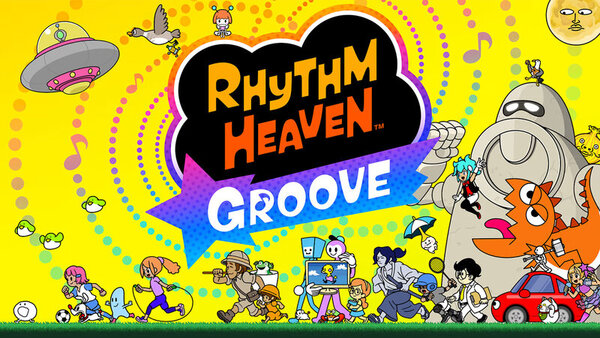
Rhythm Heaven Groove is the kind of rhythm game that can make everything suddenly click. After more than 15 hours with the Nintendo Switch version played entirely on Nintendo Switch 2, I have found myself repeatedly coming back for another minigame, another medal or another chance to get the timing just right. The formula remains wonderfully simple: listen, learn the rhythm and press the buttons at the right moment. When everything clicks, there is an unmistakable satisfaction to falling into the groove and realizing that my hands are finally following the music almost automatically.
What makes Rhythm Heaven Groove particularly impressive is how much Nintendo has packed into this package. The game includes more than 80 single-player rhythm games, along with more than 30 multiplayer games and the unlockable Beatspell mode. I have already seen the credits after completing the first eight Frontside columns, earned medals on all eight of those columns and nearly finished the Flipside. I have also completed the first few chapters of the new campaign-style mode. There is a substantial amount here, and that content makes Rhythm Heaven Groove feel considerably more substantial than many smaller rhythm games.
The individual minigames are where much of that value comes from. Rhythm Heaven Groove continues the series’ philosophy that a rhythm game does not need complicated mechanics to be entertaining, with a huge variety of strange, colorful and often completely unexpected scenarios. The controls are generally simple enough to pick up immediately, with many minigames relying on just a couple of buttons. That accessibility is important because the real challenge is supposed to come from understanding the rhythm rather than wrestling with complicated inputs.
Once I settle into a particular rhythm, the experience can be extremely satisfying. The game has a way of teaching each minigame through its music, visual cues and repetition until the pattern finally makes sense. That moment when everything falls into place is still one of the best things about the Rhythm Heaven formula. Even when the scenario itself is absurd, the underlying design is remarkably focused on getting me to listen, learn and respond.
Several minigames have stood out to me in particular. Brolly Good Show, Slice N Dice Kitchen, Sweeper Star, Fruit Flex and Flutter Speed are among the highlights of my playthrough, each providing a different take on the basic idea of matching button presses to a rhythm. Backup Spotlight is another standout thanks to its catchy music and sound effects. The sheer variety keeps the experience moving because I never quite know what Nintendo is going to ask me to do next.
The Remixes are also an important part of why the overall structure works. Rather than simply throwing another minigame at me, they combine ideas and rhythms that have already been introduced, creating satisfying culminations of what I have learned. I particularly enjoy the feeling of recognizing mechanics from earlier games and then having to apply them in a faster or more complicated sequence. The Remixes give the progression a sense of payoff without requiring the game to introduce an entirely new mechanic every time.
That progression extends beyond the core minigame lineup. Rhythm Heaven Groove includes additional modes such as Rhythm Toy Box, Score Attack and Beatspell, giving the game more ways to engage with its rhythm systems. Beatspell is an interesting attempt to build something more progression-driven around the rhythm mechanics, with rhythm-based spells used to battle monsters. In practice, though, I found the controls frustrating and repetitive. The experience never provided the same immediate satisfaction as the core minigames, and I often found myself wishing I could simply return to the main rhythm challenges. It feels like an ambitious side path that does not work nearly as well for my preferences as the straightforward minigame structure.
The biggest surprise for me has been how different the difficulty feels compared with Rhythm Heaven Fever. I loved the Wii game, and while I am not judging Groove solely on nostalgia, the difference is difficult for me to ignore. Rhythm Heaven Fever had minigames that became deeply memorable through their music, personality and the amount of effort required to master them. Air Rally, Flock Step, Flipper-Flop, Ringside, Monkey Watch, The Clappy Trio and Exhibition Match remain much more iconic to me than anything I have experienced in Groove so far.
That does not mean the new minigames are poor. Quite the opposite. I have had a lot of fun with them. The problem is that I do not feel that same sense of discovering something instantly unforgettable. Groove has a huge number of entertaining ideas, but very few have reached the level of those standout Fever experiences for me. The variety is excellent, yet the individual games do not always leave the same lasting impression.
Difficulty is another major difference. I have found it dramatically easier to earn an OK or passing result in Groove than I remember from Fever, and medals have also come much more easily. The game gives me considerably more room for mistakes while still allowing me to progress. Even the Remixes have generally been a breeze to pass. The result is a game that is extremely approachable, but one that sometimes takes away the sense of accomplishment that made the older game so rewarding.
The Flipside is a welcome addition because it gives existing ideas another opportunity to shine, but I have also found it contributes to that feeling of reduced difficulty. Many of the minigames receive alternate versions that change their patterns or presentation, yet these variations have still been relatively easy for me to clear. I have earned far more medals with less effort than I remember needing in Fever. For a series built around mastering rhythm, I sometimes wish Groove demanded more from me.
The medal and Perfect systems do provide a reason to keep returning. Once a minigame has been cleared at the required level, the game can eventually offer a special Perfect opportunity, requiring a flawless performance. I have earned two Perfects so far, and those moments are considerably more satisfying because they require much more precision than simply clearing a minigame.
My one major complaint with this system is that I cannot simply choose any minigame I want and attempt a Perfect whenever I am ready. I have to wait for the game to present the opportunity. That can interrupt the natural flow of wanting to master a particular challenge, especially when I already know I am capable of playing it perfectly. The system encourages replay, but I would have preferred more freedom in deciding when to pursue that mastery.
I also think an optional progress bar during minigames could have been useful. I understand that Rhythm Heaven traditionally avoids putting that kind of information on screen, and part of the appeal is learning the rhythm rather than watching a conventional game interface. Still, having the option would have made some challenges easier to understand without fundamentally changing the core experience.
The controls are another area where Rhythm Heaven Groove does not feel quite as natural to me as Rhythm Heaven Fever. The Wii Remote was remarkably well suited to Fever. Holding it and working primarily with the A and B buttons felt immediately intuitive, even though the actual control scheme was extremely simple. Groove maintains that philosophy of straightforward inputs, but the face-button layout on Nintendo Switch feels less natural to me. Some minigames also use more than two buttons, which makes the control scheme feel less consistent than what I remember from the Wii game.
This is particularly noticeable because the game is built around timing. When a rhythm game is asking me to react instinctively, I want the physical controls to disappear into the experience. With Groove, they occasionally remain more noticeable than I would like. It is not enough to ruin the gameplay, but it is one of the reasons I still prefer the feel of Fever.
The visual presentation is much easier for me to praise without qualification. Rhythm Heaven Groove looks colorful, vibrant and crisp, while still retaining the simple charm that has always defined the series. The art direction is intentionally uncomplicated, but the bright colors, expressive animations and strange scenarios give the game a distinctive personality. It is appealing without needing to overwhelm the screen with detail.
That visual simplicity also works particularly well with the rhythm design. The game can communicate a surprising amount through animation and timing without turning each minigame into a complicated visual spectacle. Some challenges deliberately try to distract the player visually, reinforcing the importance of listening to the music and understanding the rhythm rather than simply reacting to what appears on screen.
Not every creative decision works for me, though. Some minigames feel considerably more random than I expect from Nintendo, and A for Effort was particularly strange. The use of photographic images of real people felt completely out of place compared with the colorful, animated world surrounding it. The absurdity is part of what makes Rhythm Heaven distinctive, but this particular presentation felt less like Nintendo’s usual visual language to me.
There is also the Read-Aloud setting, which I found extremely distracting. The feature can be useful as an accessibility option, but I found the default voice extremely annoying and disruptive. Fortunately, it can be turned off in the settings. Once I disabled it, it stopped interfering with the experience.
Technically, Rhythm Heaven Groove performed extremely well for me on Nintendo Switch 2. This is not a technically demanding game, so I would not describe it as a showcase for the hardware, but it does not need to be. Load times were very short and effectively unnoticeable during my playthrough. In handheld mode, the game looks perfectly clear and feels responsive, which is exactly what I want from a rhythm game.
It also looks clean in TV mode, but this is where the Nintendo Switch 2 experience has an important limitation. Rhythm Heaven Groove is a Nintendo Switch game being played on Nintendo Switch 2 through backward compatibility, not a native Nintendo Switch 2 edition or an enhanced Switch 2 release. Nintendo lists the game as supported on Switch 2, with its game behavior consistent with the Nintendo Switch version.
For my particular experience, handheld mode was nevertheless the better way to play. The game itself warns that TV play can be less responsive because the controllers are no longer physically attached to the system, and I could feel that difference. Rhythm games are unusually sensitive to timing, so even a small difference matters more here than it would in many other genres. I had no such concern in handheld mode, which made it my preferred way to play Rhythm Heaven Groove on Nintendo Switch 2.
Because this is the Nintendo Switch version played on Nintendo Switch 2, the handheld experience is the one I would recommend based on my time with the game. The game works very well on the newer hardware, but I would not describe it as a native Switch 2 upgrade or enhanced edition.
I am also still not finished with everything I want to do, which gives Rhythm Heaven Groove a significant advantage in value from my perspective. I am still playing because I want to, not because I feel obligated to stretch a short game into a longer one. That is ultimately why I have come around to a higher score than I might have given it if I judged it primarily against Rhythm Heaven Fever. Groove does not have the same collection of instantly iconic minigames for me, and its easier difficulty and less natural controls keep it from reaching the same level. But the game is consistently enjoyable, offers a substantial amount of content and gives me plenty of reasons to keep playing. There is a lot here for $39.99, particularly if you enjoy replaying rhythm challenges, chasing medals and gradually improving your timing.
The best thing about Rhythm Heaven Groove is still the moment when everything clicks. A minigame can look ridiculous, sound completely strange and seem impossible to follow at first, then suddenly the rhythm makes sense. Once I am locked into that pattern, the controls become almost automatic and the game feels fantastic. That simple transition from confusion to understanding remains the heart of the series, and Groove produces it often enough to make the experience consistently enjoyable.
I just wish more of those moments had become as memorable to me as the best parts of Rhythm Heaven Fever. The Wii game had a control scheme that felt more natural, a tougher progression that made medals feel more meaningful and a group of minigames and songs that have stayed with me for years. Rhythm Heaven Groove has not reached that level of personal attachment yet.
Still, that comparison should not obscure what Groove accomplishes on its own terms. It is colorful, creative, packed with content and built around a rhythm system that remains wonderfully accessible. Its minigames are inventive, its Remixes provide satisfying payoffs and the amount of content gives me plenty of reasons to keep playing. Even its stranger experiments demonstrate a willingness to take the formula in different directions.
For me, Rhythm Heaven Groove is a strong return for one of Nintendo’s most distinctive rhythm series. It does not replace Rhythm Heaven Fever in my personal hierarchy, but it does not need to. Its biggest strengths are the sheer variety of its minigames, the amount of content, the appealing presentation and the satisfying feeling of finally finding the rhythm. Its reduced difficulty, less intuitive controls, Beatspell and lack of truly iconic minigames keep it from reaching the same heights as its predecessor, but they do not erase how much fun I have had playing it.
If you are looking for a Rhythm Heaven Groove review that asks whether the game is worth playing on Nintendo Switch, my answer is shaped by exactly what I experienced: there is a lot to enjoy here. And if you are playing on Nintendo Switch 2, I found the backward-compatible version particularly well suited to handheld play. It may not be the new Rhythm Heaven Fever I once imagined, but I am still happily chasing the beat.
Final Score: 8.5/10
This score reflects how much I enjoyed the core rhythm experience, the enormous variety of minigames, the colorful presentation, the satisfying Remixes and the substantial amount of content available for the asking price. The score is held back by the less natural controls compared with Rhythm Heaven Fever, a difficulty curve that feels significantly more forgiving, the lack of minigames that have become as personally iconic to me as the best of Fever, the frustrating Beatspell mode and the random nature of Perfect opportunities. Playing on Nintendo Switch 2 also works especially well in handheld mode, while TV play felt less responsive to me.
Pokémon Lens
Rhythm Heaven Groove connects to Pokémon through its emphasis on learning, repetition and mastery. Pokémon encourages players to understand different abilities and systems, while Groove introduces a constant stream of rhythm patterns that players gradually learn through repetition. The medal and Perfect systems add another layer of collection and mastery, giving players reasons to revisit challenges they have already completed. Both games turn familiarity with their systems into a form of progression, although Groove replaces Pokémon’s team-building with the pursuit of increasingly precise rhythm skills.


One thought on “Rhythm Heaven Groove Nintendo Switch Review: A Content-Rich Return That Shines on Switch 2”