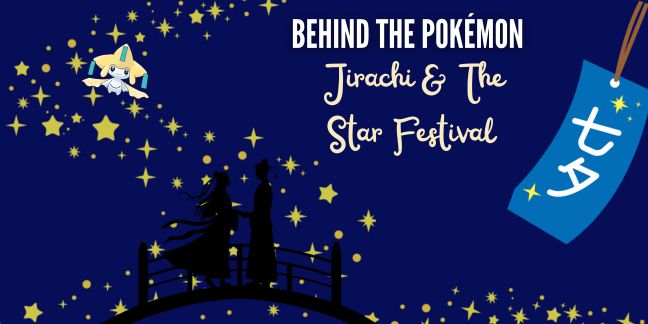
It’s the 7th day of the 7th month of the year.
People all over Japan are currently celebrating one of the most important holidays in the country.
So, what’s a better way to commemorate this festivity than by learning about the brilliant story behind the sweet mythical Pokémon Jirachi?

Before we delve into the beauty of Tanabata, let’s take a quick look at this Pokémon:
“Jirachi (Japanese: ジラーチ Jirachi) is a dual-type Steel/Psychic Mythical Pokémon introduced in Generation III.
It is not known to evolve into or from any other Pokémon.
Jirachi is a small, white, humanoid Pokémon. It has short, stubby legs and comparatively longer arms. There are flaps on the underside of its arms, which give the impression of long sleeves. On its belly is a curved seam, which conceals a third eye, known as its “true” eye. Additionally, Jirachi has a normal pair of ovalish eyes on its face, with small, blue triangular markings underneath. On its head is a large, yellow structure with three points extending outward: one from the top and one on either side. On each point is a teal tag, known as a ‘wish tag’. A rounded extension hangs from either side of the yellow structure, framing Jirachi’s face. Two yellow streamers flow from Jirachi’s back, resembling comet tails.
Jirachi hibernates for extensive periods, forming a protective crystalline shell as it sleeps. However, it is still capable of fighting while asleep if it is in danger. It awakens for seven days every thousand years, but can also waken if sung to by a voice of purity. During the short periods when it is awake, Jirachi is said to grant wishes. However, as depicted in Jirachi: Wish Maker, Jirachi cannot create an object that is desired from a wish. Instead, it teleports the desired object to the person that made the wish. In the Pokémon Adventures manga, Jirachi’s wishes are granted by writing on the three tags located on its head. Due to only having three tags, Jirachi can only grant three wishes. The anime further reveals that Jirachi’s awakening is linked to the Millennium Comet and that its third eye has the ability to absorb the energy Jirachi needs for hibernation. It is said that Jirachi’s ability to grant wishes also gives it great attack power. Although it is extremely rare, Jirachi can be found in the mountains.
Jirachi is the only known Pokémon capable of learning the move Doom Desire.“-Bulbapedia.

Tanabata, also known as “The Star Festival,” is based on the story of Vega and Altair, two star-crossed lovers who are only able to meet each other once a year and only if the skies are clear.
This tale is originally Chinese. It’s called Qixi and was brought to Japan in the 8th century.
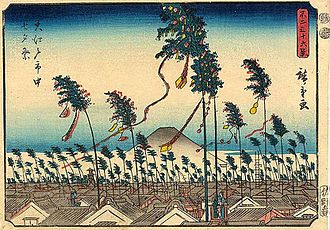
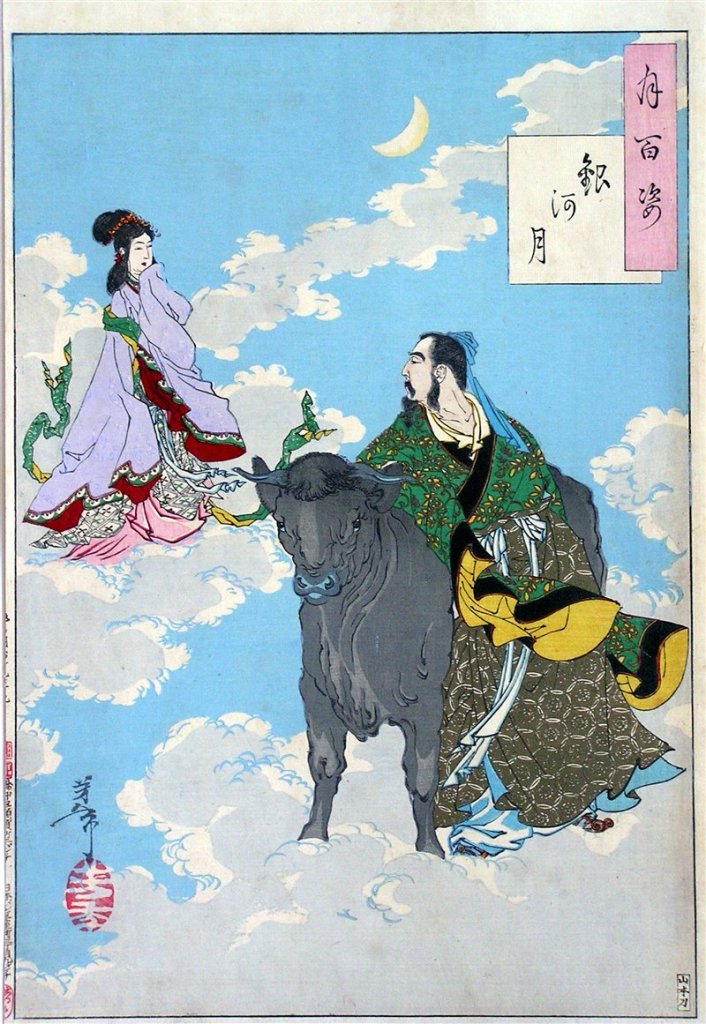
The legend narrates the story of Princess Orihime (Vega), a seamstress assigned to weave Amanogawa (The Milky Way). She worked tirelessly and became disheartened at the idea of never finding her true love.
Her father, Tentei (The Universe), was considered the father of the skies. His love for Orihime knew no bounds. He was troubled by her profound grief. Therefore, Tentei arranged for his daughter to meet Hikoboshi (Altair).
Hikoboshi was a cow herder and lived on the other side of Amanogawa.
The seamstress and the cow herder fell in love at first sight and married soon after.
The couple was so deeply in love that Orihime stopped weaving, and Hikoboshi left his herd to wander.
This behavior infuriated Tentei, and he forbade the couple to be together. A distraught Orihime pleaded with her father to reconsider his decision.
And he did reconsider his decision.
He allowed them to meet each other once a year on the seventh day of the seventh month if she worked hard and finished her weaving.
The first time they tried to meet, they found that they could not cross the river because there was no bridge. Orihime cried so much that a flock of magpies came and promised to make a bridge with their wings so that she could cross the river.
If it rains on Tanabata, the magpies cannot come because of the rise of the river, and the two star-crossed lovers must wait until another year to meet.
The rain of this day is called “The Tears of Orihime and Hikoboshi”.
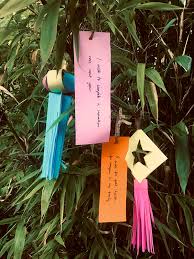
One of the customs of Tanabata is to write a wish on a colored strip of paper called tanzaku and hang it up on a bamboo tree with the hope that it becomes true.
Speaking of tanzaku, the tags of paper on Jirachi’s head are a direct reference to the traditional wishing strips.
Tanabata’s influence is not only evident in Jirachi’s star-like appearance but also in the lore that surrounds this Pokémon with the number seven (Jirachi is only awake for seven days, and the festival takes place the seventh day of the seventh month of the year).
We can conclude that the connection between Jirachi and Tanabata is one full of joy, and a meaningful example of the Pokémon franchise’s ability to incorporate folklore into its own world.
Happy Tanabata, Trainers!
May Jirachi and the tanzaku make all of your wishes come true!

