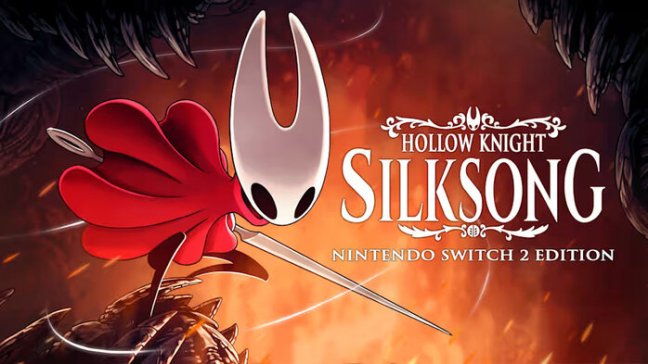
Hollow Knight: Silksong feels like the natural evolution of Team Cherry’s formula, but it is not simply a larger version of the original game. After nearly 50 hours with the Nintendo Switch 2 Edition, including completing the main journey and defeating the final boss, I came away impressed by how much Silksong expands the series while giving Hornet an identity that makes this adventure feel distinctly her own.
The first thing that stands out is how good Silksong feels to play. Hornet is faster, more mobile and more expressive than the Knight, and her movement gives the entire game a different rhythm. Her dashes, wall jumps, double jump and other abilities feel precise and controllable, making platforming one of the strongest parts of the experience. The controls rarely got in the way of what I wanted to do, which mattered during both exploration and some of the game’s more demanding encounters.
That speed also changes combat. Hornet can move around enemies with greater freedom, and the combination of her Needle, Silk abilities, Crests and Tools gives combat considerably more room for experimentation. Crests replace Hollow Knight’s Charm system, while Tools provide another layer of customization that can alter how I approached encounters. Some setups naturally encouraged different playstyles, and experimenting with those combinations became part of the fun rather than something I felt obligated to optimize.
Progression is similarly satisfying. Hornet can gain additional health and Silk, unlock new abilities and strengthen her Needle, creating a progression loop that feels familiar to anyone coming from Hollow Knight while giving Silksong its own identity. The game keeps introducing new ways to move through Pharloom and new reasons to revisit areas, so reaching the end of the main journey never felt like I had exhausted what the game had to offer.
Pharloom itself is a major achievement. The kingdom is enormous, interconnected and filled with distinct environments, yet I rarely felt completely lost about where I was. The Citadel in particular is enormous, but its scale did not make the world feel meaningless or disconnected. Areas link together in ways that generally make sense, and the game’s increasingly vertical design creates a sense of progression that felt more natural to me than the pacing of the original Hollow Knight.
Exploration is supported by a welcome increase in structure. The quest board gives me more reasons to investigate Pharloom beyond simply finding the next destination, while the Bellways make traveling around the kingdom more manageable. Bellhart became one of my favorite places to return to, partly because it feels like a genuine community and partly because the Bellhome gives Hornet a personal place to rest and expand with furniture and useful additions.
Those quieter moments are important because Silksong can be extremely demanding. The platforming is excellent, but the game also expects players to adapt quickly to unpredictable enemy movements and attacks that can take away significant amounts of health. Players coming directly into Silksong without much experience with Hollow Knight’s style may find the opening hours especially demanding. I had recently played the original game, so the transition felt natural to me, but I can see the learning curve being considerably steeper for newcomers.
The difficulty itself was rarely the reason I became frustrated. My bigger concern was how often the game made me repeat sections after a death. Boss runbacks were the clearest example. When learning a difficult boss, I expect to lose several times while figuring out its patterns, but having to repeatedly travel from a distant bench to the arena made those attempts feel more tedious than challenging. The path back was often not especially difficult. It was simply repetitive.
The same applies to some of the game’s multi-wave enemy encounters. These gauntlets can be satisfying tests of control, but I felt they appeared frequently enough that their repetition became a source of friction. The combination of long routes, limited nearby benches and losing Rosaries after death could turn experimentation into grinding. At several points, I found myself defeating enemies near a bench specifically to rebuild Rosaries so I could afford better items or recover from a previous loss. That was not the kind of repetition I found enjoyable.
The compass system also remains a design choice I have mixed feelings about. I understand the appeal of exploring Pharloom without knowing exactly where everything is, but having to equip the compass at the cost of a Tool slot never felt particularly satisfying to me. Players who prefer discovering the map completely on their own may appreciate the choice, but I generally preferred having the information available.
Despite those frustrations, the combat and boss design provide plenty of memorable encounters. There is a huge variety of enemies across Pharloom, and the game continually asks me to adjust rather than relying on one solution for every situation. Optional bosses are scattered throughout the world as well, giving exploration additional purpose. Trobbio was one of the fights that stood out to me, and the variety of optional encounters helped make Pharloom feel like a place worth investigating rather than simply a series of stages between major story moments.
The writing also benefits from Hornet being such a different protagonist. The Knight’s silence worked for Hollow Knight’s lonely atmosphere, but Hornet’s personality makes Silksong feel more immediately personable. She talks naturally with NPCs, reacts to the people around her and feels like an active participant in the world rather than an intentionally blank vessel. I found her considerably easier to connect with, and the larger number of talkable NPCs gives Pharloom more personality.
That difference became especially meaningful during some of the game’s quieter moments. Running into the wandering duo Garmond and Zaza was memorable, but the game’s treatment of its residents could be even more effective. One particularly powerful moment involved a young bug being killed by a beast. Seeing the aftermath, followed later by the town’s burial ceremony and the shrine built beside the bench where he had been, gave the world a sense of consequence that I appreciated. Pharloom can be mysterious, but it can also communicate emotion without requiring the player to decipher every piece of hidden lore.
That distinction matters because the deeper lore still does not connect with me as much as the characters and events do. Like Hollow Knight, Silksong asks players to read descriptions, examine objects and piece together information that is not always presented directly. I respect that approach and understand why it appeals to many players, but when I encounter another cryptic piece of text about some ancient object or event, I often find myself less interested than I am when the game simply lets its characters and world tell a story.
The presentation makes that world easy to appreciate regardless. Silksong’s hand-drawn art is beautiful, and Pharloom has an atmospheric identity that feels distinct from Hallownest. The environments have plenty of visual variety, while Hornet herself is much more animated than the Knight. Music is equally important. The score combines catchy melodies with a larger orchestral sound that gives major areas and boss encounters their own emotional identity.
The Nintendo Switch 2 Edition is an excellent way to experience that presentation. I played primarily in handheld mode, where the game looked exceptionally clear and remained smooth throughout my playthrough. I did not encounter performance problems, and loading was infrequent enough that it rarely interrupted the experience. The more noticeable loading moments for me came when traveling through the Bellways.
That technical consistency is particularly welcome in a game built around precise movement. Silksong demands quick reactions, and Hornet’s faster movement makes responsiveness especially important. The Nintendo Switch 2 Edition’s enhanced presentation complements the hand-drawn art without changing what makes the game itself work.
Silksong also has an impressive amount of content beyond the main journey. I have not explored all of its secret content or pursued full completion, so I would not pretend to have experienced everything Pharloom has to offer. Even after finishing the main path, however, it is obvious that there is considerably more to discover, including additional challenges, quests, bosses and progression possibilities. Steel Soul mode also provides another way to approach the game after completing the kingdom.
One area that stood out to me near the end was the final boss itself. Without getting into spoilers, the encounter looks excellent and has a memorable visual presence, but its difficulty felt surprisingly low compared with several bosses I had fought much earlier. After some of the game’s more demanding encounters, I expected the final battle to push my mastery of Hornet’s abilities further. Instead, it ended up being one of the easier major encounters in my playthrough, which made the conclusion feel a little less challenging than I expected.
That does not diminish how much I enjoyed getting there. Nearly 50 hours of exploration, platforming, combat, quests, customization and discovery gave Silksong plenty of room to justify its enormous scope. It is difficult to look at the sheer amount of content, variety and mechanical depth here and reconcile it with the idea that this was once being developed as downloadable content for Hollow Knight. The finished game feels like a substantial adventure built around a protagonist who deserved her own game.
For me, that is ultimately what makes Hollow Knight: Silksong so successful. It preserves the atmosphere, exploration and demanding combat that made Hollow Knight special while giving the formula more movement, more customization and a protagonist with a much stronger personal presence. The game is not free of friction. Boss runbacks, bench placement, Rosary recovery and repeated gauntlets occasionally made the experience feel more dated than it needed to be. The hidden lore also remains less interesting to me than the game’s character-driven storytelling.
But those limitations exist inside an adventure that consistently gave me reasons to keep exploring. Pharloom is massive without feeling empty, Hornet is fantastic to control, the world is packed with things to find and the combination of Crests, Tools and abilities gives the player meaningful ways to experiment. The Nintendo Switch 2 Edition adds the technical presentation I wanted from a fast and visually detailed 2D game, and after nearly 50 hours, I still had plenty left that I could pursue.
Hollow Knight: Silksong is not simply a bigger Hollow Knight. It is a more mobile, more character-driven and more mechanically flexible take on the same core philosophy. For me, Hornet’s adventure ultimately works because it understands what made the original compelling while being confident enough to move beyond it.
Final Score: 9.5/10
The score reflects an experience that was exceptionally strong across movement, platforming, combat, exploration, world design, presentation, character writing and mechanical variety. The Nintendo Switch 2 Edition also delivered the smooth handheld experience I wanted. What kept it from reaching the highest possible evaluation were the repetitive boss runbacks, limited bench placement, Rosary recovery grind and recurring enemy gauntlets. The final boss also did not provide the level of challenge I expected after some earlier encounters. Those limitations affected the experience without outweighing the enormous amount of creativity, content and mechanical depth I found throughout Pharloom.
Pokémon Lens
Hollow Knight: Silksong shares an interesting connection with Pokémon through experimentation and discovery. Pokémon lets players build a team around different abilities, moves and combinations, while Silksong gives Hornet that flexibility through Crests, Tools and her growing collection of abilities. Both reward players for learning how different systems interact and finding approaches that fit their playstyle. The biggest difference is that Pokémon builds attachment through companions, while Silksong creates that connection through Hornet and the characters she meets throughout Pharloom.


burn in hell you jesus god damn nigger mom
LikeLike